
















































Notification

THANK YOU FOR MAKING AN APPOINTMENT AT AIH.
Would you like to pre-register?
Please fill in the information below
Urgent
SURGICAL SAFETY AT AIH
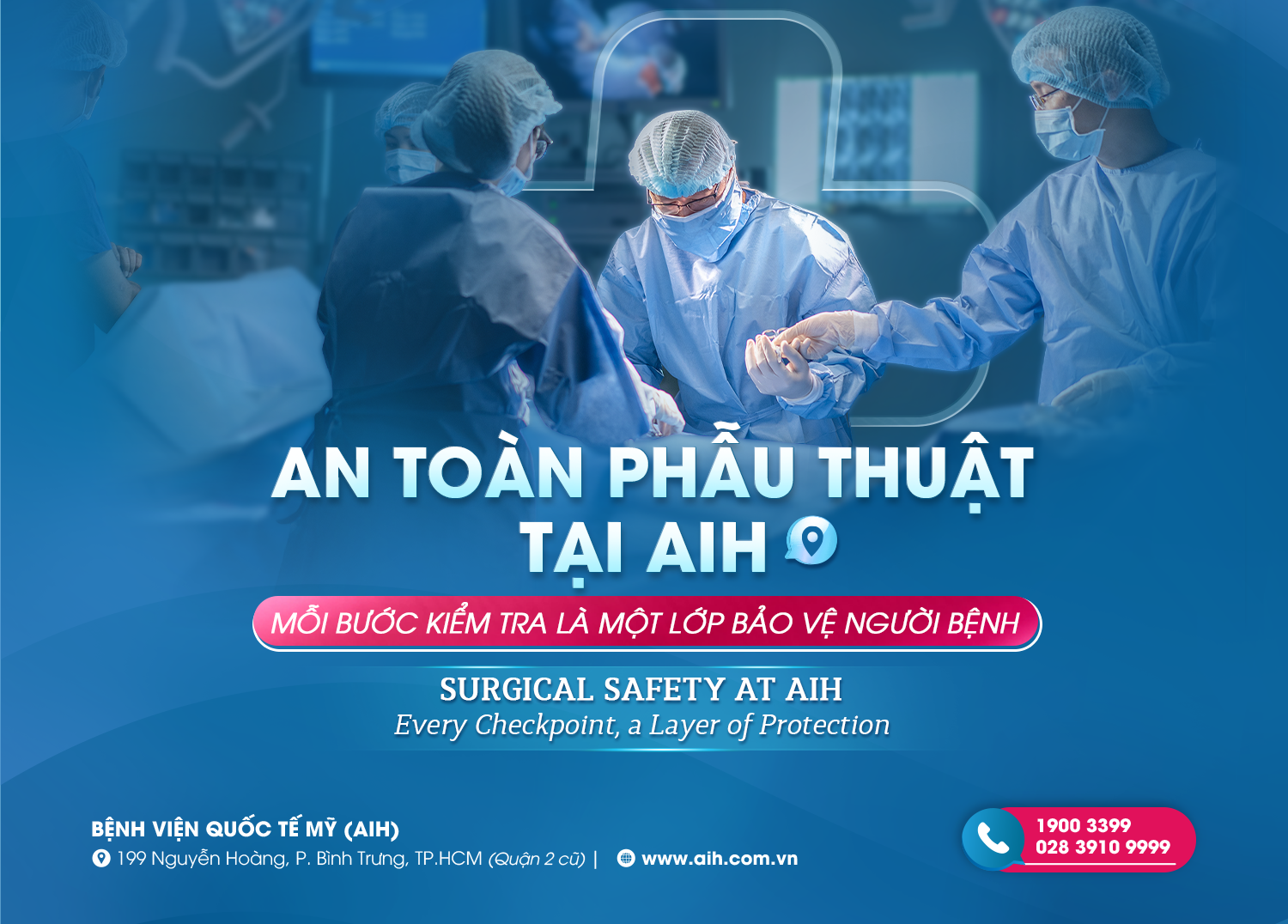
Surgery is one of the most important treatment methods in modern medicine, offering treatment opportunities and the potential to improve quality of life for hundreds of millions of patients each year. However, it is also a complex process in which many team members must coordinate precisely and efficiently within a short period of time. Many adverse events do not occur because of surgical technique itself, but because information was misunderstood or mixed up, a communication step was missed, or a necessary cross-check was not performed.
This is why WHO recommends a systematic approach to surgical safety — from infection prevention and safe anesthesia to teamwork, effective communication, and outcome measurement. As part of the Safe Surgery Saves Lives initiative, WHO developed the WHO Surgical Safety Checklist — a 19-item tool designed to reduce errors and adverse events while strengthening communication, coordination, and cross-checking among members of the surgical team.
From International Recommendations to Practice at AIH
At American International Hospital (AIH), surgical safety is implemented on the foundation of recommendations from the Ministry of Health, WHO, and the JCI quality standards, which serve as the basis for standardizing the hospital's processes and practice guidelines. These principles are translated into concrete checkpoints throughout the surgical journey – from pre-operative preparation, through the operating room, to the handover of the patient for post-operative care.
Multi-Layered Verification Before Surgery
Patient information and the treatment plan are verified through multiple steps — from pre-operative preparation, informed consent, and pre-anesthesia assessment to handover to the operating room team — all aimed at one overarching goal: RIGHT PATIENT –RIGHT SITE –RIGHT PROCEDURE
Each confirmation adds another layer of protection, helping to detect and prevent errors before the intervention is carried out.
Marking the Surgical Site
When indicated, the surgical site is directly identified and marked by the surgeon before anesthesia or sedation, in accordance with hospital regulations. The site is marked using a method that is clear, easily recognizable, and remains visible after the patient has been prepped and draped. For cases where direct marking is not appropriate, an alternative confirmation method is applied in accordance with hospital policy.
This is an important protective layer, allowing the team to reconfirm the surgical site before the intervention begins.
“Stop – Look– Listen”. The three moments — SIGN IN, TIME OUT, and SIGN OUT — are critical safety pauses during surgery, allowing the team to jointly check and confirm necessary information before moving to the next step:
SIGN IN — Before anesthesia, the team confirms key information about the patient, the planned procedure, and relevant risks.
TIME OUT — Before the start of surgery or incision, the entire team pauses together to confirm the patient, surgical site, planned procedure, and any safety concerns that require attention.
SIGN OUT — Before the patient leaves the operating room, the team confirms key items such as instrument, sponge, and needle counts; specimen identification; and the post-operative care plan.
At AIH, these three safety pauses are integrated into surgical practice procedures, creating an opportunity for team members to jointly check, confirm, and proactively communicate before moving to the next step. During TIME OUT, every team member is responsible for participating in the confirmation process and speaking up whenever something is unclear or poses a risk to patient safety. This is a core part of building a “SPEAK UP FOR PATIENT SAFETY” culture at AIH. Because a question raised at the right moment can help prevent an error before it happens.
AIH: Monitoring to Ensure Safety in Practice
At AIH, surgical safety does not stop at simply asking whether the checklist was completed. AIH maintains regular compliance monitoring in the operating room, assessing the actual level of team engagement during the SIGN IN, TIME OUT, and SIGN OUT moments — whether the team truly pauses, confirms information together, listens, and responds to safety information. This approach is designed to ensure that the checklist does not become a mere formality but truly serves as a communication and cross-checking tool in patient care — sustained through the coordination of surgeons, anesthesiologists, nurses, and all team members involved in the care process, rather than relying on the effort of a single individual.
The Patient Is Also a Member of the “Safety Team”
Surgical safety is not solely the responsibility of physicians, nurses, or the hospital — patients and their families can also add an extra layer of protection.
Ask — “What procedure will the doctor perform, and at what site?”
Speak up — Fully disclose allergy history, current medications, underlying medical conditions, and other important health information.
Confirm — Proactively re-check important information whenever something is unclear.
Speak up — Immediately inform medical staff if any information does not match what was previously discussed.
When patients see healthcare staff asking to re-verify their identity, checking the surgical site, or pausing together before the operation begins, this is not because the team “doesn’t remember the information.” It is because patient safety must always come first, and every piece of information is worth double-checking.
AIH’s Commitment to Safety in Every Surgery
Surgical safety is built from actions that may seem small: one confirmation, one marked site, one identified risk, one instrument counted, and one voice speaking up at the right moment. Each action is a layer of protection, all working toward one goal: RIGHT PATIENT –RIGHT SITE – RIGHT PROCEDURE
At AIH, we maintain, monitor, and continuously improve our surgical safety practices so that every step of care is carried out with checking, coordination, and accountability.
Check one more time.
Ask one more question.
Pause at the right moment.
Because patient safety always comes first. AIH – Safety in Every Step of Care
References
Ministry of Health of Vietnam. Circular No. 19/2013/TT-BYT dated July 12, 2013, guiding the implementation of healthcare service quality management in hospitals.
Joint Commission International Accreditation Standards for Hospitals (Version 8 2025).
World Health Organization. WHO Surgical Safety Checklist and Implementation Manual – Safe Surgery Saves Lives. WHO, 2009.
Haynes AB, et al. A Surgical Safety Checklist to Reduce Morbidity and Mortality in a Global Population. New England Journal of Medicine. 2009;360:491–499.
De Vries EN, et al. Effect of a Comprehensive Surgical Safety System on Patient Outcomes. New England Journal of Medicine. 2010;363:1928–1937.
Urbach DR, et al. Introduction of Surgical Safety Checklists in Ontario, Canada. New England Journal of Medicine. 2014;370:1029–1038.
--------------------

Leave a comment